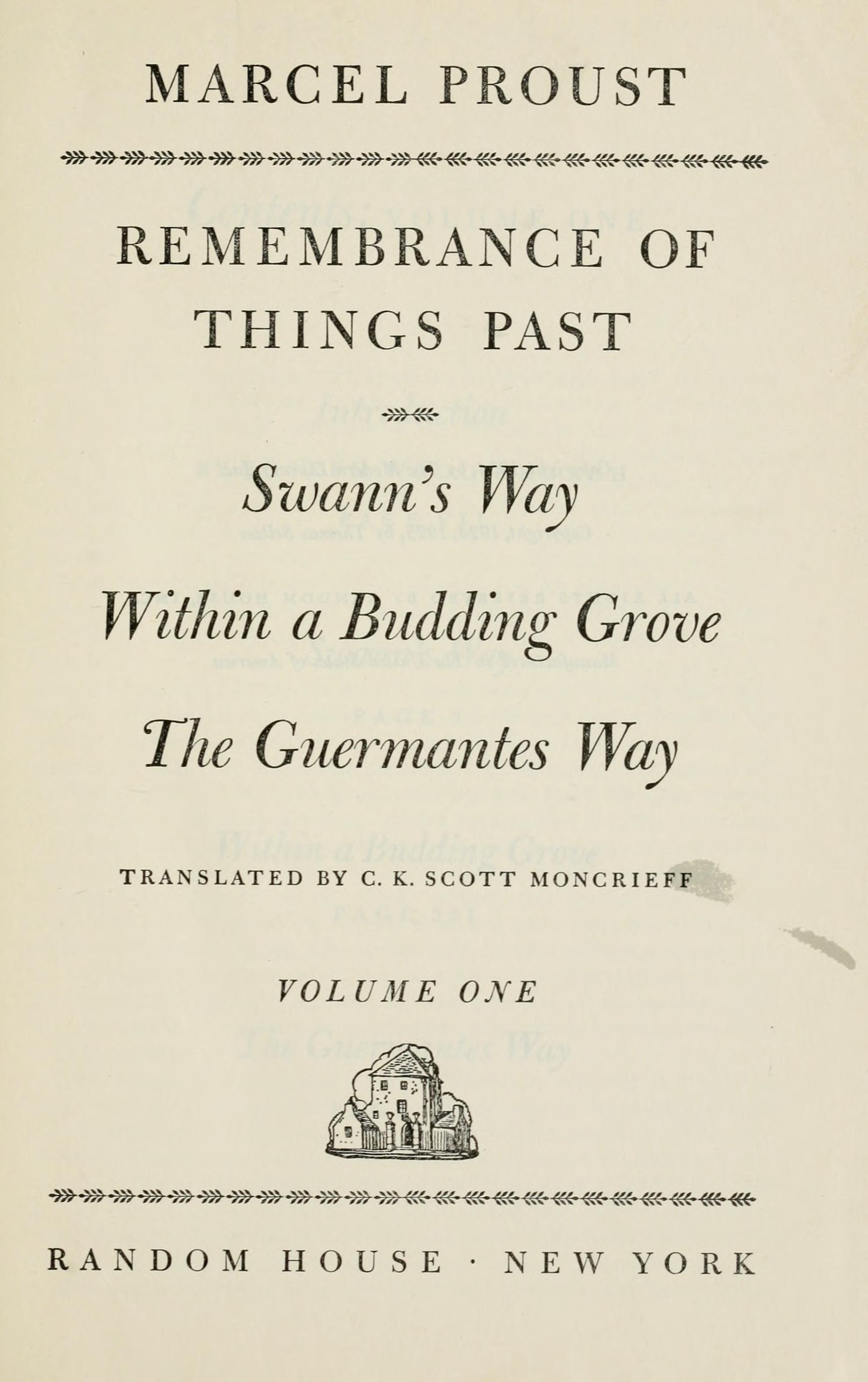
Remembrance of Things Past
- Yayıncı
- Penguin
- Sayfa
- 1197
- Dil
- English
- Yayın yılı
- 1986
Özet
Remembrance of Things Past is one of the monuments of 20th century literature. Neville Jason's widely praised 36 CD abridged version has rightly become an audiobook landmark and now, upon numerous requests, he is recording the whole work unabridged which, when complete, will run for some 140 hours.<br/><br/>This bundle includes all seven volumes of this landmark work:<br/><br/>Swann's Way<br/>Within a Budding Grove<br/>The Guermantes Way<br/>Sodom and Gomorrah<br/>The Captive<br/>The Fugitive<br/>Time Regained<br/>Remembrance of Things Past<br/>The critic André Maurois described Proust’s Remembrance of Things Past as ‘one of the greatest works of the imagination of all time’.<br/>The literal translation of the work’s French title, ‘In Search of Lost Time’, contains within it a clue to the creation of this monumental work of biographical fiction. Having wasted time living a dilettante existence in the fashionable world, Proust, in middle age, decided to re-dedicate his life to art, and to attempt at last to achieve the great work of which he knew himself capable.<br/>Remembrance of Things Past was his chance to justify his life, and to cheat death through an act of artistic creation. It was the means he would use to conquer time through recreating his lost years. Memory was the material with which he would weave the magic cord to be launched into infinity; that cord which now binds us to him, and stretches forward into the future, linking his genius to unborn generations.<br/>The Author<br/>Marcel Proust was born on 10 July, 1871. His father, a distinguished professor of medicine, was from a Catholic family, while his mother was Jewish. Although convinced from an early age of his calling as a writer, Proust was riddled with self-doubt and wrote relatively little at the beginning of his career.<br/>During his twenties, he co-founded a short-lived review, Le Banquet;contributed to another literary publication, La Revue Blanche; and in 1896 had his first book published, a collection of essays entitled Les Plaisirs et Les Jours.<br/>He became an enthusiastic admirer of Ruskin and translated his Bible of Amiens and Sesame and Lilies into French. A novel, Jean Santeuil, which was the precursor of Remembrance of Things Past, was abandoned, and eventually published long after Proust’s death, in 1954. For much of his youth Proust led the life of a man-about-town, frequenting fashionable Paris drawing rooms and literary salons, which were to form the background of a number of his early stories and sketches, and subsequently of Remembrance of Things Past.<br/>The death of his adored mother in 1905 resulted in a nervous collapse and aggravated his chronic asthma and insomnia. But, despite his grief and the sense of loss, from which he never recovered, his mother’s death freed him with regard to his homosexual way of life, and allowed him to address same-sex love in his writing, albeit in a form which treated such experiences as happening to others rather than to himself.<br/>In 1907 he moved into an apartment in the Boulevard Haussmann where, in the bedroom which he had had lined with cork to keep out noise, he embarked upon his great work À la Recherche du Temps Perdu (Remembrance of Things Past). In it the minuteness of his observation, the depth of his psychological understanding and the vividness of his descriptive powers combined to create one of the most poetic and magical works in all literature.<br/>Publication of Remembrance of Things Past<br/>This long autobiographical cycle was originally published in eight sec
Bu kitap hakkında gönderiler
Bu kitap hakkında henüz gönderi yok. Uygulamada ilk paylaşan sen ol!


