
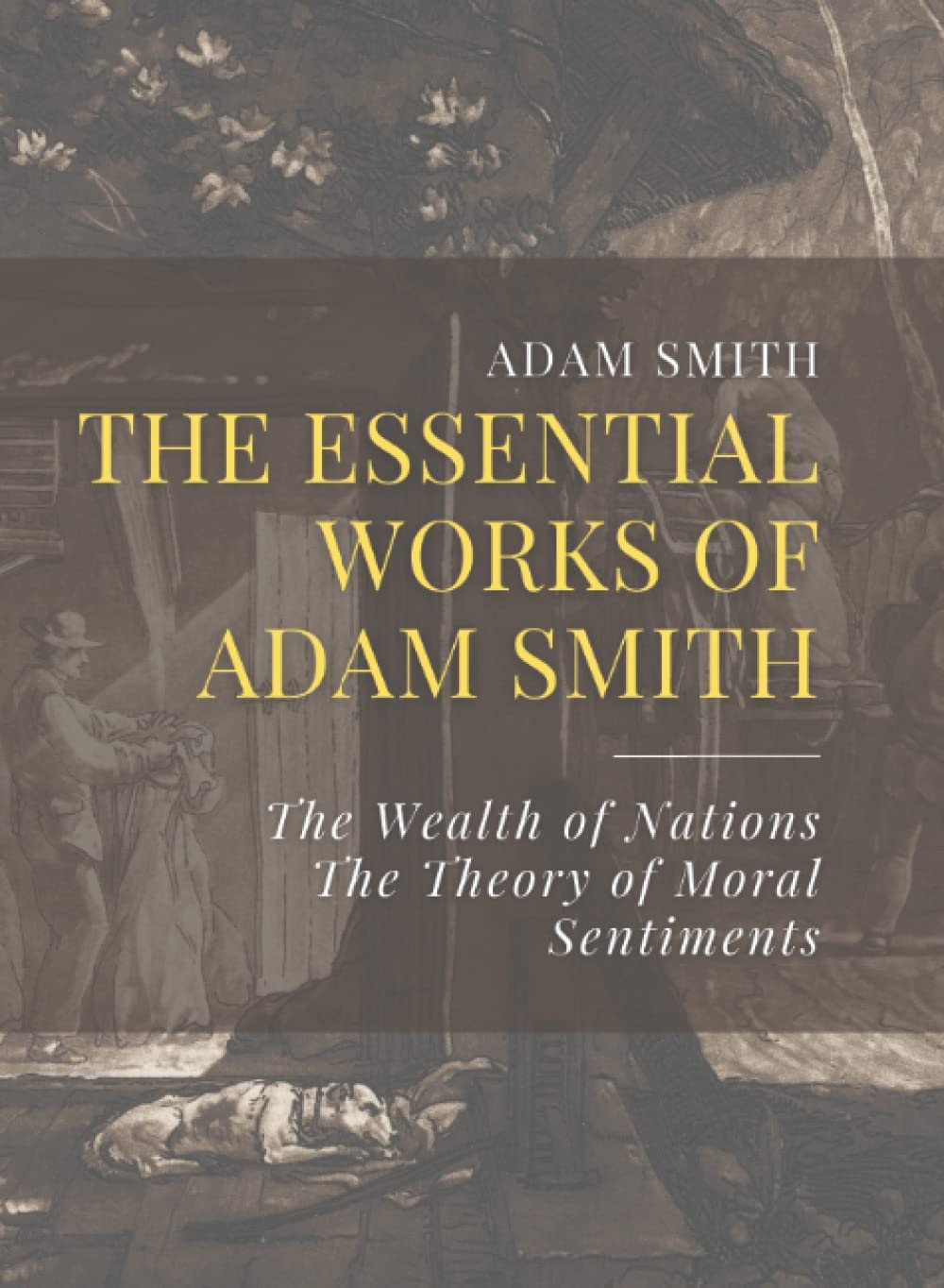
by Smith, Adam
The Essential Works of Adam Smith present sin one volume Scottish economist and moral philosopher Adam Smith's two most important and influential works: The Wealth of Nations and The Theory of Moral Sentiments.<br/><br/>Adam Smith's seminal work, An Inquiry Into the Nature and Causes of the Wealth of Nations (most commonly referred to as The Wealth of Nations) was first published in 1776 and is widely regarded as a landmark in the field of economics. The book revolutionized the way economists, politicians, and scholars thought about wealth creation and its effects on society. Through rigorous analysis and advocacy of free markets, Smith provided a comprehensive overview of essential economic concepts, such as the divisions of labor, productivity, and the power of free markets.<br/><br/>Smith's earlier work, The Theory of Moral Sentiments (1759), is often cited as having greater philosophical value than The Wealth of Nations. In this treatise, Smith explored how human conscience is developed from social relationships, emphasizing the need for “mutual sympathy of sentiments” among mankind in order to form moral judgments. Both works remain essential to understanding the development of economic thought and remain influential to this day.<br/><br/>Adam Smith (1723-1790) was an eminent Scottish economist, philosopher, and author. His most famous work, The Wealth of Nations, is considered to be the foundation of modern economic theory. Smith was born in Kirkcaldy, Scotland, and attended the University of Glasgow, where he studied moral philosophy. After leaving the University, he travelled extensively throughout Europe, meeting with influential thinkers such as Voltaire, Rousseau, and Benjamin Franklin. Upon his return home, Smith held a series of positions, including professor of logic at Glasgow, professor of moral philosophy at Edinburgh, and commissioner of customs in Edinburgh. During this period, Smith wrote two of his most famous works: The Theory of Moral Sentiments, and An Inquiry into the Nature and Causes of the Wealth of Nations. The Theory of Moral Sentiments introduced the concept of the “invisible hand”, a notion that individuals in a free market economy will act in their own self-interest, but in a way that ultimately benefits society. An Inquiry into the Nature and Causes of the Wealth of Nations established Smith’s reputation as one of the fathers of modern economics. In it, Smith argued for free markets, free trade, and the division of labor, among other ideas. Adam Smith is widely regarded as one of the most influential economists of all time. His works remain essential reading for those studying economics, philosophy, and the history of economic thought.
No posts about this book yet. Be the first in the app!


