
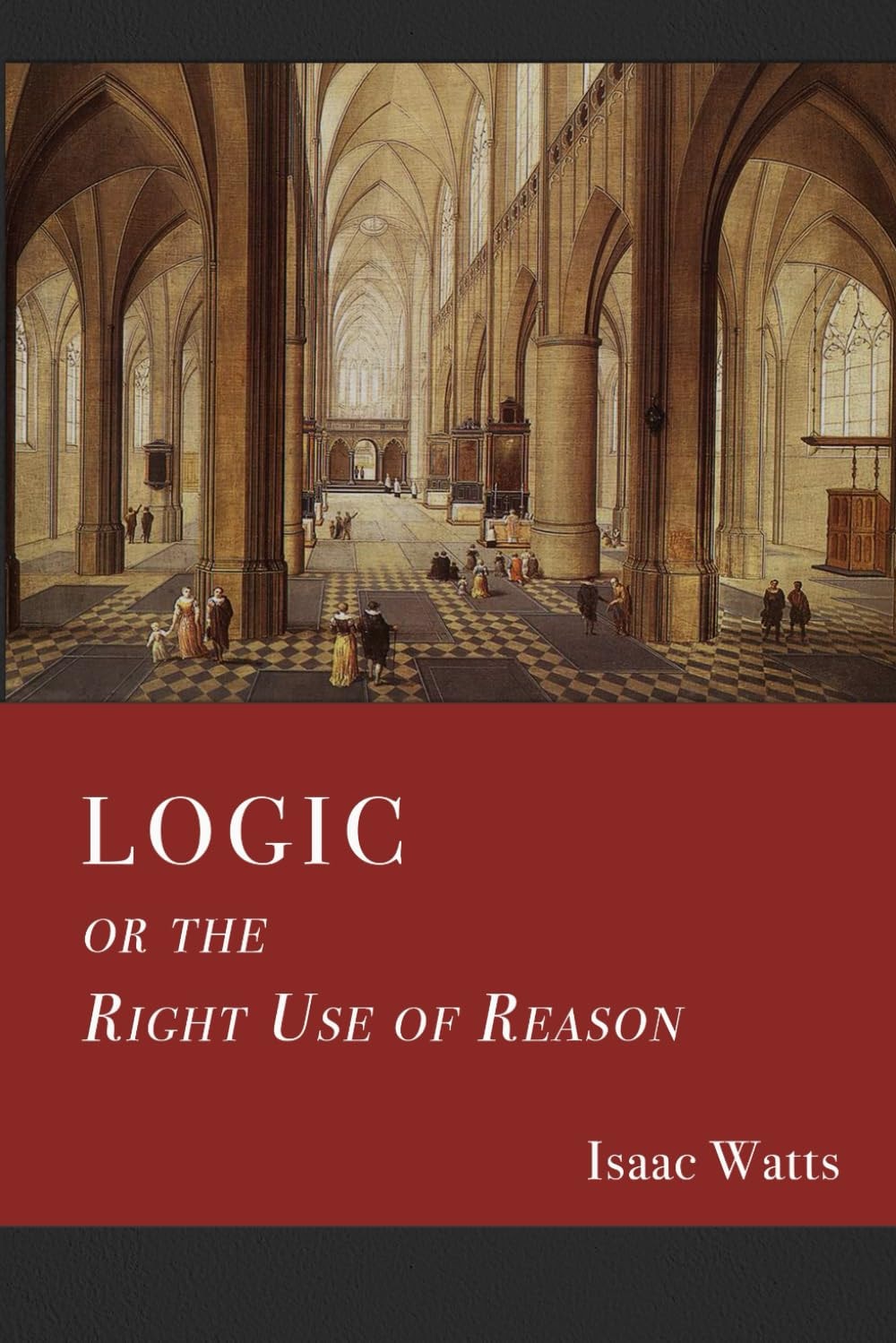
by Watts, Isaac
Logic was a standard textbook on the subject for almost two centuries. First published in 1724, Watts examines the most fundamental question of all: how do we know that something is true? In four parts, he discusses words, propositions, syllogisms, and the other building blocks of human thought. Later on, Watts famously wrote The Improvement of the Mind as a companion to this work.<br/><br/>This edition is a reproduction of a modernized edition of Watts' work, so the spelling is updated for modern readers. Though Watts calls upon his readers to think, his book is still very accessible for the average reader.<br/><br/>Isaac Watts (1674–1748) was an English nonconformist minister, song writer, theologian, and logician. He was a popular hymn writer and is credited with more than 750 hymns. His songs include "When I Survey the Wondrous Cross," "Joy to the World," and "Our God, Our Help in Ages Past.” He is considered the father of English hymnody. Watts also wrote widely-used guides on astronomy, geography, grammar, and philosophy. First written in 1724, Logic, The Right Use of Reason in the Inquiry After Truth was a standard textbook on logic for 200 years.<br/><br/>Contents of Logic<br/>The Introduction, and general scheme<br/>The First Part, namely, of Perception and Ideas<br/>Chapter 1 — Of the nature of ideas<br/>Chapter 2 — Of the objects of perception<br/>Chapter 3 — Of the several sorts of perceptions or ideas<br/>Chapter 4 — Of words, and their several divisions, together with the advantage and danger of them<br/>Chapter 5 — General directions relating to our ideas<br/>Chapter 6 — Special rules to direct our conceptions of things<br/>The Second Part, namely, of Judgment and Proposition<br/>Chapter 1 — Of the nature of a proposition, and its several parts<br/>Chapter 2 — Of the various kinds of propositions<br/>Chapter 3 — The springs of false judgment, or the doctrine of prejudices<br/>Chapter 4 — General directions to assist us in judging aright<br/>Chapter 5 — Special rules to direct us in judging of particular objects<br/>The Third Part, namely, of Reasoning and Syllogism<br/>Chapter 1 — Of the nature of a syllogism, and of the parts of which it is composed<br/>Chapter 2 — Of the various kinds of syllogisms, with particular rules relating to them<br/>Chapter 3 — The doctrine of syllogisms<br/>Chapter 4 — Some general rules to direct our reasoning<br/>The Fourth Part, namely, of Method<br/>Chapter 1 — The nature and kinds of method, viz. natural and arbitrary, synthetic and analytic<br/>Chapter 2 — General and special rules of method
No posts about this book yet. Be the first in the app!


